What Workflows does
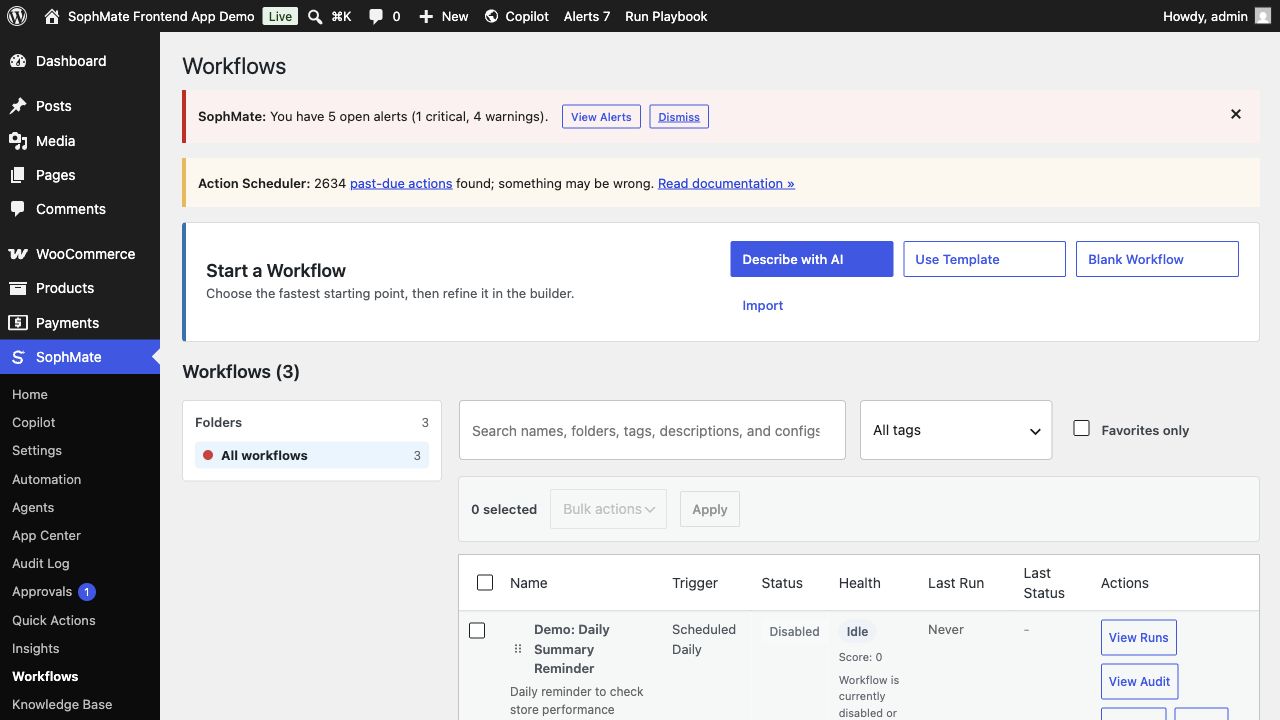
Build repeatable workflows from templates, blank workflows, or plain-English descriptions, then review runs, audit events, errors, and health metrics.
SophMate is built for WordPress and WooCommerce teams that want useful AI help without turning the site into an invisible automation box. The module keeps the work close to wp-admin, where products, orders, pages, policies, users, and operational history can be reviewed by the people responsible for the site.
Best-fit teams
- Operations teams ready to turn a proven manual process into a monitored workflow with triggers, steps, approvals, and run history.
- Developers and site managers who need workflow execution to remain inspectable after launch instead of disappearing into custom code.
- Teams that want WordPress-native context, permission checks, and audit history instead of a disconnected AI workspace.
- Buyers evaluating whether the module can fit a real operating process, not only produce an impressive demo response.
What teams see in wp-admin
The Workflows area shows creation paths, templates, run history, health panels, and analytics in one place. Operators can move from a plain-English workflow idea to a structured trigger-and-action draft, then review run output before broad production rollout.
Best-fit jobs
- Draft a daily store summary reminder from plain English.
- Create follow-up workflows for delayed orders or low stock.
- Review run health before enabling workflows on production stores.
Product capabilities
- Describe-with-AI workflow creation
- Templates and blank builder
- Run history and audit export
- Workflow analytics
- Import and marketplace paths
Setup prerequisites
- Map the trigger, owner, approval requirement, affected records, failure path, and rollback path before enabling any workflow on production data.
- Confirm scheduled task reliability, provider limits, and run-history visibility before relying on repeated workflow execution.
- Set provider budgets and role access before giving users a workflow that can become a site-changing plan.
- Keep staging, backup, or rollback expectations clear whenever the feature can affect public content, commerce data, customer messages, or theme output.
Operating notes
Start with a low-risk example, check the visible output, and promote the pattern only after the team can explain the inputs, review point, owner, and rollback path.
Rollout checklist
- Run in draft, simulation, or low-risk mode first, then enable production schedules after several clean runs.
- Keep kill switches and failure notifications visible to the workflow owner during the first monitoring window.
- Name the owner of the first rollout window and schedule a review before making the feature a default team habit.
- Capture what changed during the first run so future administrators can distinguish setup mistakes from product behavior.
Risks and guardrails
- Risk: workflow execution can repeat a bad assumption. Guardrail: use simulation, approvals, kill switches, and run-history review before full scheduling.
- Risk: provider or cron failures can leave tasks half-finished. Guardrail: monitor failures, retries, and affected records.
- Treat convenience as a rollout risk whenever the feature can write data, contact customers, publish content, or change the storefront.
- Keep permissions, budgets, audit review, and rollback expectations visible during the first production use.
When to use a different path
Do not automate a process that the team cannot explain manually. If the owner, trigger, data source, failure path, and rollback behavior are unclear, keep the workflow in draft or simulation mode.
How it stays governed
The important pattern is draft, review, approve, then execute. Read-only questions can stay conversational. Work that affects products, coupons, content, customers, workflows, images, or settings should move through a reviewed plan, workflow run, or publishing step. That is why Workflows belongs beside approval-based action plans, audit and diagnostics controls, and the broader SophMate tutorial library.
Evidence to capture
- Capture trigger, run ID, input payload summary, step results, approval events, errors, retries, affected records, and final status.
- Keep evidence from dry runs so later production failures can be compared against the expected path.
- Link evidence to the relevant docs, tutorials, or use case when the feature becomes part of a repeatable operating procedure.
- Keep evidence concise enough for support and governance review; avoid exporting secrets or unnecessary customer data.
What to measure after rollout
Review run success rate, failures by step, manual interventions, cost, pending approvals, and alert volume. Repeatable work should become more predictable over time.
Decision record
- Record the workflow owner, trigger, approval model, monitoring window, kill switch, and rollback route before enabling production schedules.
- Write down the first production scenario, the reviewer, and the evidence that would prove the rollout is working.
- Revisit the decision after the first incident, failed run, support ticket, or policy change rather than letting the original setup become permanent by accident.
Where to go next
Compare this module against the rest of the SophMate feature library, map it to a team scenario in use cases, or start with a practical guide from SophMate tutorials.