WooCommerce operations 7 min read May 25, 2026

How to Find Margin Leaks in WooCommerce

Use SophMate Insights to find WooCommerce margin leaks caused by discounts, refunds, shipping patterns, and low-profit product mixes.
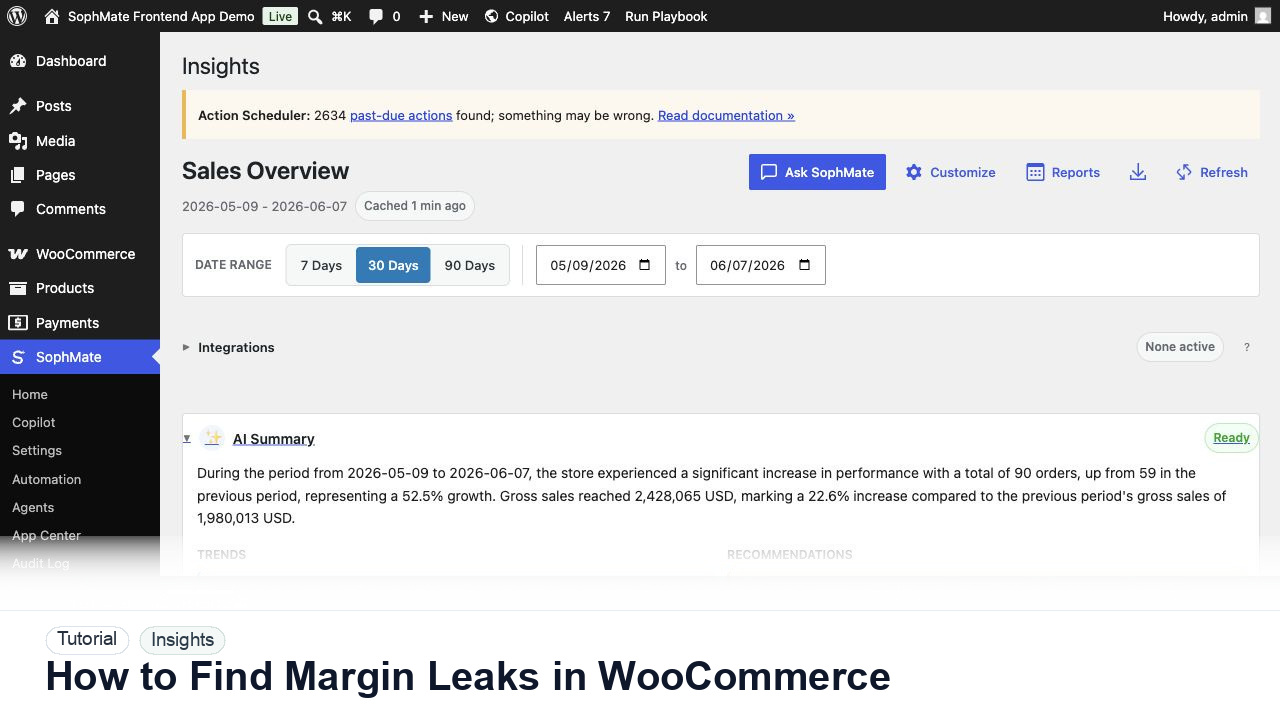
SophMate tutorial image for How to Find Margin Leaks in WooCommerce showing the related wp-admin workflow context.

Outcome

By the end of this tutorial, you will know how to use SophMate for finding WooCommerce margin leaks while keeping the work reviewable inside WordPress.

Scenario

A store owner sees revenue rising but cash flow feels tighter, so the team needs to identify whether refunds, discounts, or product mix are hiding a margin problem.

WooCommerce pain point

WooCommerce can show sales and orders, but the limitation is that margin pressure often hides across refunds, discounts, shipping patterns, campaign timing, and low-profit product mix. The buyer problem is not "what was revenue"; it is "why did revenue fail to turn into healthier profit."

SophMate resolution path

  • Use SophMate Insights to compare the campaign period with a baseline and keep refunds, discounts, and attribution visible.
  • Ask for margin suspects, then verify the AI summary against product reports, refund records, and campaign spend.
  • Move any coupon, price, stock, or campaign response into an approval-backed action plan.

What to avoid in WooCommerce

  • Do not treat an AI summary as accounting, tax, financial close, or pricing approval.
  • Do not change prices or coupons until the suspected leak has source evidence and an owner.
  • Do not ignore refunds, stacked discounts, and shipping cost assumptions when revenue looks healthy.

Buyer evaluation note

Use this tutorial to evaluate whether SophMate keeps WooCommerce reporting reviewable rather than turning AI summaries into business authority. Reports should preserve date range, refund, discount, margin, attribution, export, and approval context.

When not to use this workflow

  • Do not use Insights as accounting, tax, financial close, pricing approval, or client billing authority.
  • Do not act on a summary when refunds, discounts, attribution, margin assumptions, or date ranges are unclear.
  • Do not use this workflow to bypass the normal owner, reviewer, or approval path for production changes.
  • Defer the workflow when the source data, permission boundary, rollback owner, or customer impact cannot be explained.

Example operator request

Review these WooCommerce sales trends for decision support. Compare date range, refunds, discounts, margin context, attribution caveats, and recommend only reviewed next steps.

What the image shows

The tutorial image shows SophMate Insights context where sales trends, refunds, margin, goals, AI summaries, exports, and report schedules are reviewed before business decisions are made.

Before you begin

  • Choose the date range, timezone, comparison window, refund handling, discount context, margin assumption, and attribution source before asking for interpretation.
  • Decide who owns any follow-up action because reports should support decisions, not approve pricing, coupon, stock, or client-billing changes by themselves.
  • Confirm SophMate is active, diagnostics do not show blocking failures, and the current user role can open the relevant SophMate module.
  • Check provider, budget, privacy, and approval settings before asking SophMate to draft or execute work.
  • Keep customer data, API keys, purchase codes, and private credentials out of prompts unless this workflow explicitly requires and permits that context.

Access and data boundary

  • Limit reporting review to users who can see WooCommerce performance, refunds, campaign context, and approved business metrics.
  • Use aggregated ranges, exported summaries, and redacted examples instead of raw customer lists, payment details, or order-level data unless the decision requires record-level review.
  • Use the least-privileged SophMate role that can complete the review, and keep administrator-only access limited to setup, provider, billing, diagnostics, and high-risk approval work.
  • Prefer record IDs, short excerpts, and redacted screenshots over full customer records, payment details, provider keys, purchase codes, or raw server logs.

Guardrail

Treat AI summaries as decision support, not approval to change prices, coupons, stock, campaigns, customer segments, or financial reporting.

Common mistakes to avoid

  • Reading one headline metric without checking refunds, discounts, margin, inventory, campaign dates, and attribution limits.
  • Treating an AI summary as a finance report or approval to change coupons, prices, stock, or campaign spend.
  • Sharing exports with clients before redacting private customer, order, payment, and internal margin context.

Step 1: Open the right reporting window

Go to SophMate > Insights and compare the current campaign period with a baseline period that has similar seasonality. Keep date range, timezone, refunds, discounts, and attribution visible.

Step 2: Ask SophMate for margin suspects

Ask Copilot or Insights to summarize products, categories, coupons, refunds, and order patterns that may explain why revenue is not turning into healthier margin.

Step 3: Separate signal from accounting

Treat the AI summary as operational triage, not final accounting. Compare findings with product reports, refund records, shipping costs, and campaign spend before making pricing decisions.

Step 4: Turn one finding into a reviewed plan

If a coupon or product update is recommended, ask SophMate to create an action plan with affected records, reason, approval owner, and rollback notes.

Step 5: Schedule a repeat check

Create a recurring report or workflow so margin leaks are reviewed weekly during campaign periods instead of after a month of avoidable discounting.

Review checklist

  • The analysis includes refunds and discounts.
  • At least one suspected margin leak has source evidence.
  • Any pricing or coupon change moves into approval review.

Production readiness

  • Confirm the date range, timezone, refunds, discounts, attribution source, margin assumptions, and comparison baseline before using summaries for decisions.
  • Route campaign, coupon, stock, pricing, or customer-impacting recommendations through the proper approval path instead of acting from the report alone.
  • Run the workflow first on a narrow, low-risk record or page before expanding scope.
  • Confirm the reviewer, approval rule, and evidence location before any production-changing action runs.

Failure modes to test

  • Test misleading date ranges, missing refund context, attribution gaps, margin assumptions, export failures, and report-driven recommendations that require approval.
  • Confirm financial or customer-impacting decisions do not proceed from an AI summary alone.
  • Test the path where the user lacks permission, required context is missing, or the reviewer rejects the result.
  • Confirm the failed state leaves an audit record, visible owner, and clear next action instead of a silent or ambiguous outcome.

Success signal

The reporting workflow is successful when the date range, refunds, margin context, attribution caveats, export evidence, and approval handoff are clear before any business action follows.

Post-run monitoring

  • Compare the AI summary against visible charts, WooCommerce reports, refunds, discount activity, attribution source, and exported evidence after the first review.
  • Watch whether suggested follow-up actions create approval plans, campaign briefs, or watcher thresholds instead of untracked manual changes.
  • Review the audit log, diagnostics, and affected WordPress records shortly after the first run.
  • Record any confusing output, missing source context, permission issue, cost spike, or reviewer correction before repeating the workflow.

Safe expansion criteria

  • The report baseline, date range, refund handling, margin context, attribution source, and export evidence are accepted by the business owner.
  • Follow-up actions have named owners and approval routes before the reporting workflow becomes recurring or client-facing.
  • The first run has a documented owner, evidence, review result, and stop path.
  • A second operator can repeat the workflow from the notes without relying on hidden context.

Rollback or stop path

If report context is incomplete or misleading, stop any campaign, coupon, stock, pricing, or customer-impacting follow-up until the date range, source data, refunds, margin assumptions, and owner review are corrected.

What to document

Document report date range, timezone, comparison window, refund and discount context, attribution caveats, export location, summary owner, and any approved follow-up action.

Owner and cadence

The store owner, finance owner, or marketing lead should review reports before decisions. Use this workflow after campaigns, monthly reviews, seasonal spikes, or unusual refund and margin changes.

Escalate when

Escalate when reports drive pricing, stock, coupon, campaign, client billing, financial, or customer-impacting decisions and source data, attribution, refunds, or margin assumptions are unclear.

Common questions

Can Insights replace accounting or financial close reports?

No. Insights is decision support for operators. Accounting, tax, margin close, and financial reporting should stay in the systems and review processes responsible for those records.

Does this workflow remove the need for human review?

No. SophMate should make the work easier to draft, inspect, approve, and repeat. Human review remains necessary when output affects customers, money, published content, privacy, settings, or workflow execution.

What should be documented before expanding the workflow?

Record the owner, input scope, access boundary, approval point, failure modes tested, evidence location, monitoring window, and rollback or stop path.

Next action

Use this report once as a decision review baseline. If it leads to a coupon, campaign, stock, pricing, or client-reporting decision, route that follow-up through the relevant approval or campaign workflow and keep the export attached to the decision record.

Next step

Bring this workflow into your WordPress site

Review the SophMate listing for current package details, screenshots, compatibility notes, and license terms.

View on CodeCanyon

Related

More from WooCommerce operations

Pro