Workflows and operations 6 min read Mar 20, 2026

Validate Tools Library and MCP Calls Before Agents Use Them

Review Tools Library categories, schemas, permissions, MCP calls, marketplace imports, and agent visibility before production use.
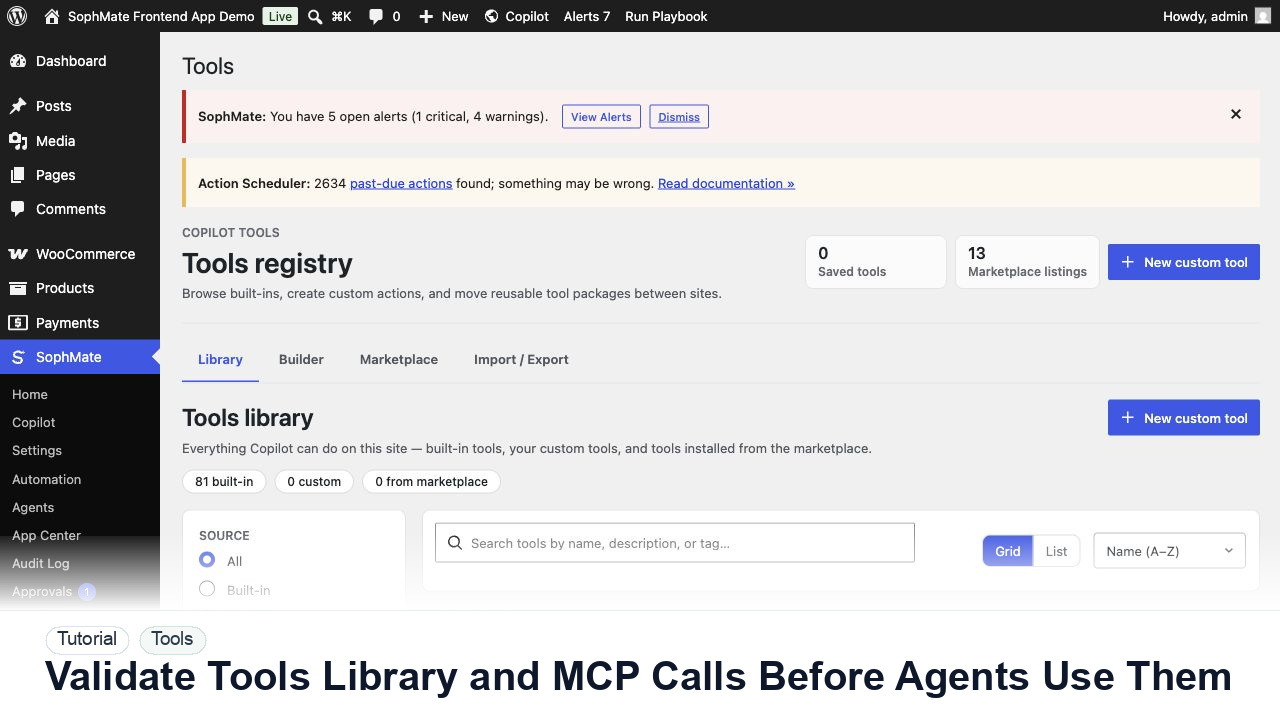
SophMate tutorial image for Validate Tools Library and MCP Calls Before Agents Use Them showing the related wp-admin workflow context.

Outcome

By the end of this tutorial, you will know how to use SophMate for SophMate Tools Library MCP while keeping the work reviewable inside WordPress.

Scenario

A developer imports a tool preset and wants an agent to use it only after schema, permission, and audit behavior are proven.

Buyer evaluation note

Use this tutorial to evaluate whether SophMate custom tools are safe enough for real WordPress operations. Buyers should see schema validation, malformed-input tests, permission denial, retry behavior, risk classification, and audit output.

When not to use this workflow

  • Do not expose a custom tool to agents after only a happy-path sample.
  • Do not classify a tool as low risk when it can write records, call external services, read sensitive data, or trigger side effects.
  • Do not use this workflow to bypass the normal owner, reviewer, or approval path for production changes.
  • Defer the workflow when the source data, permission boundary, rollback owner, or customer impact cannot be explained.

Example operator request

Validate this custom tool before agents use it. Test schema, malformed input, permission denial, external failure, retry behavior, risk classification, and audit output.

What the image shows

The tutorial image shows the Tools registry because custom AI capabilities should be reviewed by schema, category, visibility, and risk before agents or workflows can use them.

Before you begin

  • Define the tool schema, allowed callers, risk classification, permission boundary, retry behavior, and audit output before exposing it to agents or workflows.
  • Prepare malformed input, permission denial, external failure, and duplicate-run tests before treating the tool as production-ready.
  • Confirm SophMate is active, diagnostics do not show blocking failures, and the current user role can open the relevant SophMate module.
  • Check provider, budget, privacy, and approval settings before asking SophMate to draft or execute work.
  • Keep customer data, API keys, purchase codes, and private credentials out of prompts unless this workflow explicitly requires and permits that context.

Access and data boundary

  • Define the smallest schema, permission set, data capture, and audit output that lets the tool complete its job.
  • Do not expose write-capable or external-service tools to agents or workflows until invalid input, permission denial, and retry behavior are tested.
  • Use the least-privileged SophMate role that can complete the review, and keep administrator-only access limited to setup, provider, billing, diagnostics, and high-risk approval work.
  • Prefer record IDs, short excerpts, and redacted screenshots over full customer records, payment details, provider keys, purchase codes, or raw server logs.

Guardrail

Do not expose custom capabilities to visitors, agents, or workflows until roles, permissions, schemas, and risk level are clear.

Common mistakes to avoid

  • Letting agents use a tool before schema validation and permission checks are proven.
  • Classifying a write-capable tool as low risk because it usually handles safe examples.
  • Logging full payloads when a shorter audit record would explain the run without exposing sensitive data.

Step 1: Inspect the library entry

Review category, type, description, visibility, schema, risk level, and whether the tool reads data, writes data, or calls an external service.

Step 2: Run schema tests

Test valid input, missing required fields, malformed values, permission denial, timeout, and external-service failure.

Step 3: Check MCP call boundaries

For MCP-backed tools, verify discovered method names, allowed parameters, response shape, error shape, and audit fields before agent access.

Step 4: Limit agent visibility

Expose the tool only to the agent or workflow that needs it, and keep write-capable tools approval-gated.

Step 5: Review marketplace imports

Treat imported tools as untrusted until local credentials, permissions, and failure behavior are reviewed on this site.

Review checklist

  • Schema tests cover failure paths.
  • MCP calls leave useful audit records.
  • Agents see only reviewed tools.

Production readiness

  • Validate schema, permissions, sample payloads, error handling, risk level, and audit output before exposing the tool to agents or workflows.
  • Test malformed input and permission failures before testing happy-path tool calls.
  • Run the workflow first on a narrow, low-risk record or page before expanding scope.
  • Confirm the reviewer, approval rule, and evidence location before any production-changing action runs.

Failure modes to test

  • Test malformed payloads, missing required fields, permission denial, timeout, external-service failure, retry behavior, and audit output.
  • Confirm agents and workflows cannot use the tool outside the reviewed schema and risk boundary.
  • Test the path where the user lacks permission, required context is missing, or the reviewer rejects the result.
  • Confirm the failed state leaves an audit record, visible owner, and clear next action instead of a silent or ambiguous outcome.

Success signal

The tool workflow is successful when validation, permission checks, risk classification, sample runs, and audit records make the tool safe enough for the intended agents or workflows.

Post-run monitoring

  • Review validation failures, permission denials, audit records, external-service responses, and unexpected payload shapes.
  • Watch whether agents or workflows call the tool outside its intended risk boundary.
  • Review the audit log, diagnostics, and affected WordPress records shortly after the first run.
  • Record any confusing output, missing source context, permission issue, cost spike, or reviewer correction before repeating the workflow.

Safe expansion criteria

  • Schema, permissions, fallback states, jobs, audit fields, and visitor-facing behavior pass negative and happy-path tests.
  • Custom capabilities remain limited to the roles, agents, or workflows that were explicitly reviewed.
  • The first run has a documented owner, evidence, review result, and stop path.
  • A second operator can repeat the workflow from the notes without relying on hidden context.

Rollback or stop path

If a custom capability behaves unexpectedly, disable the app or tool, revoke visitor/agent access, preserve audit evidence, and retest schema plus permissions.

What to document

Document manifest or tool schema, permissions, data captured, risk classification, fallback behavior, and audit fields.

Owner and cadence

The developer owns schema and integration behavior, while the administrator owns permission, risk, and visitor-facing placement.

Escalate when

Escalate when custom capabilities read sensitive data, write WordPress records, call external services, or expose visitor-facing behavior.

Common questions

What makes a custom capability ready for production?

It needs a clear schema or manifest, least-privilege permissions, negative tests, fallback states, audit fields, and an owner who can disable it quickly.

Does this workflow remove the need for human review?

No. SophMate should make the work easier to draft, inspect, approve, and repeat. Human review remains necessary when output affects customers, money, published content, privacy, settings, or workflow execution.

What should be documented before expanding the workflow?

Record the owner, input scope, access boundary, approval point, failure modes tested, evidence location, monitoring window, and rollback or stop path.

Next action

Run schema, permission, malformed input, retry, and audit-output tests before exposing the tool to an agent, workflow, or visitor-facing app.

Next step

Bring this workflow into your WordPress site

Review the SophMate listing for current package details, screenshots, compatibility notes, and license terms.

View on CodeCanyon

Related

More from Workflows and operations

Pro